The short answer: Australia’s position in the Southern Hemisphere. This means the sun is in the north for the majority of the day, enabling the highest energy generation.
But what about if your roof faces east, west, or south?
There’s a lot more that goes into determining the best way for solar panels to face in Australia. While north-facing panels often make the most sense, other orientations can still be effective.
Here, we’ll explore why solar panels face north in Australia and when other orientations make sense.
How the Sun Moves Across the Sky in Australia
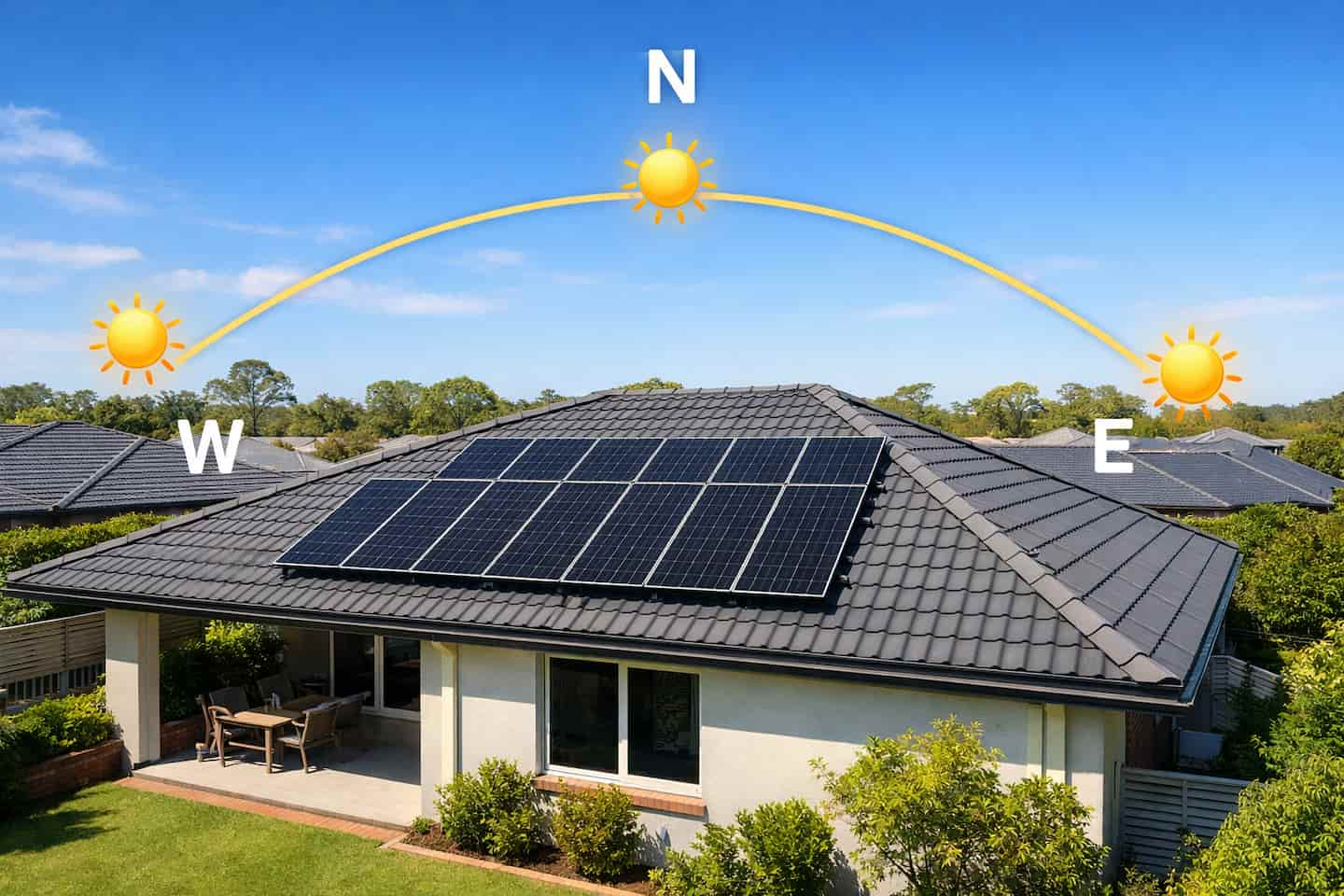
In Australia, the sun tracks across the northern part of the sky. The sun rises in the east, sets in the west, and sits to the north at midday. This position allows North-facing panels to capture more sunlight across the day and throughout the year.
In winter, shorter daylight hours and a lower sun angle decrease how much sunlight can be captured. Still, north-facing panels maximise the amount of sun exposure year-round, optimising energy generation.
Learn more about how solar panels capture sunlight and turn it into usable energy here: How do solar panels work?.
Why North-Facing Solar Panels Generate the Most Power Overall
Here are the main reasons north-facing solar panels generate maximum energy in Australia compared to other orientations:
- Longer daily exposure to sunlight
- More consistent year-round generation
- Better winter performance
- Higher total annual energy yield
For a closer look at why Australia supports such strong solar performance, see our blog here: Benefits of Solar Energy in Perth.
Does Every Home Need North-Facing Solar Panels?
While north-facing solar panels are ideal in Australia, orientation is only one factor in performance. Location and tilt also play significant roles in energy production.
Many Australian homes lack perfect north-facing roofs, but non-ideal roof layouts can still be efficient.
Regardless of your roof’s orientation, your home can most likely benefit from a well-designed solar system. Next, we’ll explore how other orientations can still generate clean energy and save home and business owners money.
You May Also Like: How Much Roof Space Do You Need For Solar Panels
East-Facing vs West-Facing Solar Panels
East-Facing Solar Panels
Strong points of East-facing solar panels:
- Strong energy generation in the morning
- Useful for early-day electricity use
- Can reduce grid reliance before midday
If you do not have a north-facing roof, we recommend east-facing panels if you use most of your energy in the morning.
Examples where East-facing panels may be ideal:
- Big families who use a lot of hot water in the morning for showers
- Households with peak energy usage in the mornings
- Commercial Businesses that require a lot of power in the morning (ie, bakeries or cafes)
- If your west-facing roof is heavily shaded
- Afternoon or night shift workers who are primarily home during morning hours
West-Facing Solar Panels
Strengths of west-facing solar panels:
- Strong afternoon and evening energy generation
- Better alignment with after-work usage
- Useful when evening energy consumption is higher
West-facing solar panels can be ideal for:
- Homes that use most of their energy during the afternoon or early evening hours
- Homeowners who use air con to counteract scorching afternoon temps
- Homeowners who work early and are gone for the start of the day but home during the afternoon/evenings
- Areas where electricity rates are higher in the afternoon or evening hours
East–West Split Systems Explained
If north-facing solar panels do not work for your home, a common alternative is east-west split solar systems. In this setup, panels are split across the east and west roof faces.
This setup performs similarly to north-facing panels, generating only slightly lower peak output.
If your energy usage is relatively consistent throughout the day, you may benefit from east-west split solar systems. This setup will match the flatter energy generation curve throughout your day.
East-west panels often align better with real household usage, making it a great compromise if north-facing panels are not possible.
What Is the Best Solar Panel Tilt Angle in Australia?
Solar panel title refers to how much a panel is angled from the ground. The best solar panel tilt angle in Australia is usually similar to your area’s altitude. Optimal angles can vary based on the time of year and your goals.
Seasonal Solar Tilt Adjustments in Australia and Special Considerations
We generally recommend setting the tilt slightly less than your approximate latitude. This angle ensures the summer sun is favoured while still balancing winter output. From there, we can fine-tune it according to your energy usage and needs.
Here are some examples of how tilt can be adjusted depending on the goal:
- Self-Cleaning: A 10 to 15 degree tilt helps prevent grime/dust buildup. This angle allows rain to naturally wash away dirt to keep the panels cleaner.
- Heavy Energy Usage in the Winter Months: A steeper vertical tilt (Latitude plus approx 15°) helps better capture winter sun, which is lower in the sky. This solar panel tilt is ideal if you want to capture as much winter sunlight as possible for heavy winter energy usage.
- Majority of Energy Use in Summer: A shallower panel tilt (latitude approx. – 15°) is best for capturing as much light as possible from the higher summer sun. This is an ideal tilt for households that consume more energy during the summer months.
- Balanced Energy Use Year-Round: If your energy use is relatively stable throughout the year, a fixed tilt close to your location’s latitude will likely be the most efficient.
- Flat Roofs: Flat roofs are often fitted with tilt frames (situated at around 15°) to ensure debris and water can be shed more easily
Learn more about how a solar panel’s angle affects sunlight absorption here: How Solar Panels Work.
When Non-North-Facing Solar Panels Still Work Very Well
With continuing advancements in solar panel technology, there is a wider range of flexibility when it comes to installation.
Whether your roof faces north, west, east, or even south, we can help you determine the most efficient setup.
Australia’s climate is well-suited to excellent solar panel performance. If your roof doesn’t face north, you can still enjoy strong solar output.
To ensure the strongest energy generation, we evaluate your setup, orientation, and other considerations, including:
- Shading considerations
- Roof layout
- Planning constraints
- Battery storage to reduce reliance on midday generation
- Energy use patterns
- Location
You May Also Like: Lifespan of a Solar Panel in Australia
Common Myths About Solar Panel Direction
Here are some of the myths about solar panel direction we hear the most:
- Solar Panel Myth: Solar only works if panels face north
- Fact: Solar panels can work well in Australia, even in non-north-facing orientations
- Solar Panel Myth: East or west panels are not worth installing
- Fact: East or west-facing solar panels can still provide clean, cost-effective energy
- Solar Panel Myth: Tilt does not matter in Australia
- Fact: Solar panel tilt significantly affects energy generation and efficiency
- Solar Panel Myth: South-facing panels are pointless in Australia.
- Fact: While we prioritise other orientations, south-facing solar panels in Australia are becoming more popular. South-facing panels may work if you consume the majority of your energy during winter compared to the summer months.
Read more solar myths and facts in our guide here: Debunking the Top 10 Solar Myths.
The Key Takeaway for Australian Homeowners
Australia’s conditions are ideal for taking advantage of the benefits of solar panels. North-facing panels maximise annual output, but east and west-facing systems can still perform extremely well.
Here’s the biggest thing we want you to remember: System design and energy use patterns matter more than perfect orientation.
With over a decade of experience in the renewable energy sector, we’ve designed and installed hundreds of residential solar systems. Our experts can guide you through the entire process, including determining the ideal solar panel orientation for your setup.
We design solar systems that match your energy use habits, goals, location, and home to optmise your energy generation.
If you are curious about the ideal solar setup for your home or business, contact us for a free quote.