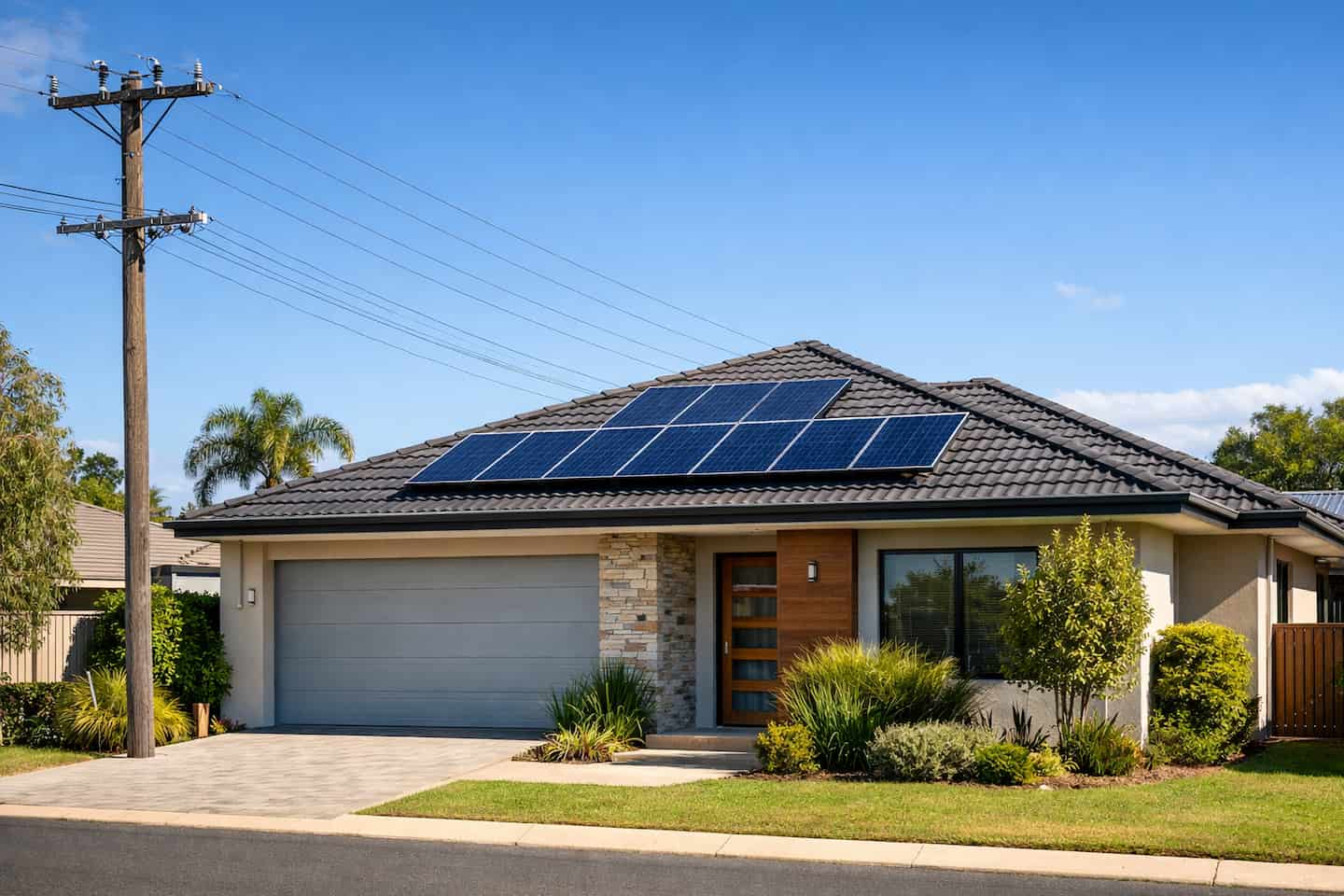
Single-phase connections feature a single circuit, provide 240V power, and are standard in most Australian homes. Three-phase power involves four wires, 240V and 415V power, and is better suited to larger homes.
Choosing between single-phase vs three-phase solar systems depends on your property’s power supply, energy use, and future plans.
Here, we’ll cover single-phase vs three-phase solar systems and which setup makes the most sense for your property and energy usage habits.
Key Summary
- Single-phase power is standard in most Australian homes and involves one active and one neutral wire.
- Three-phase power features three active and one neutral wire, providing both 240V and 415V power.
- Single-phase solar is usually enough for standard homes with average power use.
- Three-phase solar can suit larger homes, businesses, workshops, EV charging, and bigger systems.
- If a property has three-phase power, it does not always need a three-phase inverter.
- Local network rules can affect system size and export limits.
- Three-phase solar systems typically have higher export limits.
What Is Single-Phase Power?
Single-phase wiring means your home is connected to the grid via one active wire and one neutral wire. Single-phase power is the standard electrical supply for most Australian homes and small businesses, providing 240V.
Single-phase is common in Australian homes and is usually enough for normal household energy usage, such as:
- Televisions
- Fans
- Lighting
- Refrigerators
- Heating
- Standard Appliances
- Laptops
- Single-phase solar systems
What Is Three-Phase Power?
Three-phase power involves three separate phases using four wires (1 neutral, 3 active). Three-phase is designed to support larger or more demanding loads and is more common in some larger homes and commercial properties.
Three-phase enables single-phase power (240V) and three-phase power (415V) from the same supply.
Three-phase power is better suited to larger buildings or higher electrical demands, such as:
- Workshops
- Ev charging
- Machinery
- Pool pumps
- Large air con systems
- Three-phase solar
Single-Phase vs Three-Phase Solar Systems: What’s the Difference?
| Single-Phase | Three-Phase | |
| Type of Property | The majority of Australian residences | Commercial buildings; larger homes with high energy demands |
| Power Supply | 240V | 240V and 415V |
| Inverter Options | Single-phase inverter | Suitable for either a single-phase or three-phase inverter |
| Typical System Size | Smaller; often limited to 5 – 10kW total system size | Supports larger systems, often up to 15kW to 30kW |
| System Flexibility | Limited | Greater flexibility regarding system design and load balancing |
| Export Potential | More restricted; 5kW is a common limit | Allows for higher export potential |
| Suitability for EVs and Batteries | Not as ideal | Better suited for home EV charging setups |
| Likely Cost Difference | Typically 10 to15% lower than three-phase | Higher than single-phase |
You May Also Like: Advantages and Disadvantages of Solar Power
Do You Need Three-Phase Solar if your Property has Three-Phase Power?
No, not every three-phase property needs a three-phase solar setup. The Australian Government states that a three-phase property can generally use either a single-phase inverter or a three-phase inverter.
Deciding between single-phase vs three-phase solar systems as the best option depends on:
- Energy usage and habits
- System size
- Available roof space
- Future loads
- Your location (Western Australia requires a three-phase inverter for solar systems larger than 5kW)
A three-phase inverter may be better when the property has high power demand or needs a larger system. Three-phase inverters also balance solar production across the three phases. This increases overall efficiency while reducing the risk of voltage overload.
You May Also Like: What Size Solar Battery Do I Need?
When Single-Phase Solar Is the Right Choice
Single-phase solar can be an excellent option for the majority of residential homes. It works especially well in residences that have existing single-phase power, moderate energy usage, and average roof space.
Single-phase solar is straightforward, cost-effective, and well-suited to average household energy demands.
A single-phase solar system is usually best suited for residences with:
- An existing single-phase connection (the majority of Australian homes)
- Average daily household electricity use
- No unusually large appliances
- Lower upfront cost preference
- Moderate-sized solar system goals (approx. 6.6 kW to 10 kW system sizes)
- Small to medium air conditioning systems
- Limited roof space
- No plans to add EV charging in the future
When Three-Phase Solar Makes More Sense
Three-phase solar is often best suited to:
- Larger homes
- Commercial sites
- Workshops or sheds
- Heavy daytime loads
- EV charging
- Homes with swimming pools or large air con systems
- Future battery plans
- Larger solar systems where network rules allow
How Export Limits Can Affect Your Solar System Size
Solar export limits refer to how much excess energy you are allowed to feed back to the grid. These export limits are set by DNSP (Distributed Network Service Providers) in Australia. Find your location’s DNSP here: Who is your distributor? | Australian Energy Regulator (AER).
Export limits vary by network and state, but per-phase limits matter when comparing single-phase vs three-phase solar systems.
3-phase power typically has higher export limits, often up to 15 kW. Single-phase systems are commonly capped to 5 kW to 10kW.
For example:
- Energex Export Limits: Up to 10 kW per phase for dynamic connections and up to 5 kW per phase for basic connections.
- Essential Energy Export Limits: Flexible exports range from 1.5 kW to 10 kW per phase, depending on local network capacity.
- Western Power Export Limits: Western Power emphasises that design and connection approval rules and phase arrangements directly affect solar possibilities.
Standard exports are commonly capped at 1.5 kW for single-phase properties. 3-phase properties may also be limited to 1.5 kW export caps in rural networks to stabilise the grid. Larger solar systems in high-capacity areas are generally capped at 5 kW.
For a more detailed look at exporting solar to the grid, see our guide here: How Much Solar Can I Export to the Grid in Australia?
Can You Upgrade from Single-Phase to Three-Phase Power?
Yes, it is possible to upgrade from single-phase to three-phase power. Upgrading typically involves switchboard, metering, wiring, and network approval changes.
While upgrading is technically possible, be aware that this is an expensive, complex process. It may not be worth it for every home, but upgrading may be worth considering for larger future energy plans.
If you are wondering if upgrading to three-phase power makes sense for you, we recommend consulting with a solar technician.
You May Also Like: How Long for Solar Panels to Pay Off in WA?
Single-Phase vs Three-Phase Solar for Batteries and EV Chargers
Solar batteries can work on both types of power supply. Many residential battery systems are designed to operate on single-phase power.
It’s important to remember, especially in backup scenarios, that not every setup will automatically power everything during an outage. This makes backup design a crucial factor to consider.
The Australian Government’s battery guidance emphasises that battery design on a three-phase property can be more complex.
Although three-phase battery systems are pricier, their advantages include:
- Higher flexibility
- Excellent backup power storage for all three phases
- Excellent blackout protection
- Increased energy independence
- Larger capacity
Learn more about solar battery installation and options here:
- Solar Battery Installation Sydney
- Solar Battery Installation Brisbane
- Solar Battery Installation Adelaide
You May Also Like: Can You Really Use Solar When the Grid Goes Down?
How to Check Whether Your Home Is Single-Phase or Three-Phase
Checking whether your home is single-phase or three-phase is usually fairly simple. We recommend checking the switchboard and meter box, or checking your electricity bill.
Your switchboard can be found in your meter box. There, it will either feature a single or three-pole switch:
- A three-pole main switch equals three-phase power.
- A one-pole main switch means single-phase power.
Still unsure about single-phase vs. three-phase power and which connection your home has? To be sure, ask a qualified solar installer or electrician.
You May Also Like: Are Solar Batteries Safe? What You Need to Know Before Summer
Which Option Is Best for Your Property?
Deciding between single-phase vs. three-phase solar systems depends on your existing supply, network rules, and electricity usage and habits.
If you have a standard household and average energy use, single-phase solar is usually fine.
A three-phase solar system may be a better fit if you have higher energy demands from:
- A larger home
- A workshop
- EV plans
- Wanting a bigger system in the future
- A pool
- A large air con system
The best way to decide between single-phase vs. three-phase solar systems is with a professional consultation.
Our solar technicians can evaluate your location, export limits, grid connection, roof space, and energy usage. We’re here to guide you to ensure your system is as efficient and effective as possible for your location and energy needs.
Whether you are interested in commercial solar or residential solar, we can streamline the design and installation of your solar system. Contact us to schedule your solar consultation or get a quote.